RESEARCH FOCUS -
BUILDING VIRTUAL TEAMS
Different Types of
Teams
Project teams are mainly structured, by function,
towards the goals and achievements of the project, such as the programming team, or the design team. These, co-located,
teams usually report directly to the Project Board, or project management
team and use their management styles and operations. Together, these
groups form the traditional, or Main Team (MT).
Sometimes there is a need to establish project teams,
with similar structures, which are located away from the MT, - the VT.
These VT are often required within large / complex partnership projects,
when several nations are involved, or contractors / suppliers take on a
large amount of project risk. Such projects are often seen complex, yet
are considered to be very significant to the organisations, or nations
involved. Examples of these types of project include: New aircraft,
Communications systems, Space exploration, Pioneering medicinal centres.
Within these types of project, VT may need to be established for a variety
of reasons:
- Multiple
partner location;
- Multiple
sites required for safety and security;
- Outsourcing
and provision of key services;
- Provision
of specialist services;
- Risk
reduction and mitigation;
The VT may also have a variety of traditional project
teams attached to them, on a long term or temporary basis. However, each
VT will report directly to the Management Board, either through physical
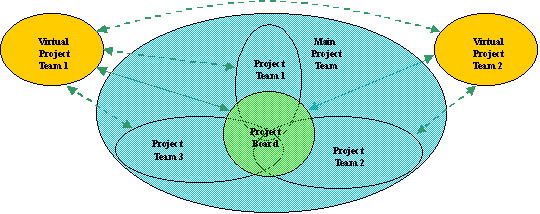
representation, or electronically. The relationship between VT and the
elements of the traditional project team are shown below.
Figure 2.
Relationships Between Different Types of Project Teams
VT evolve with a number of differences compared to traditional project
teams. This is usually because:
- Communications
methods and styles may be different;
- Different
types of reward and recognition schemes will be encountered;
- Geography
and distance will require different timings;
- Priorities,
objectives and timescales may be different;
- There
will be a variety of work cultures and management styles involved;
- Various
types of technology and systems will be encountered;
- Quality,
safety and security standards may differ;
|